Friday, June 28, 2019

COURSE RENOVATIONS SPRING 2019


It has been brought to my attention that many members, were not aware of the changes coming to Hole #10 this spring and were surprised to see what looked like disruptive change as construction progressed. I want to apologize for this as it has been in the works for a long time and since it was constantly in my life, I assumed everyone knew about it…. 


The changes were made for a variety of reasons, but one important consideration was to make the course more friendly to higher handicappers and beginner/occasional golfers, while still maintaining and even raising the challenge and beauty of the hole for the experienced players. Other important considerations were to reduce maintenance where possible and to enhance some of the least attractive bunkers on the course. 


A couple of years ago LedgeRock was a trial course for a new USGA program to see how courses play, how layout effects players of different abilities, and how traffic patterns effect maintenance. This program, using GPS to track players, provided some invaluable information to the club. Around the same time the club was talking to Rees Jones about updating features of the course and making it easier to maintain where possible while also making it more accessible for players of all abilities. After 10 years of play, it was time to see what tweaks could be made to make the course better. Bryce Swanson (Rees’ lead designer) did an initial evaluation, and it was surprising that (unknown to him) a lot of his observations paralleled those of the USGA report. 


Some of simpler and inexpensive tweaks came right away with more tree removal and the change in the fairway lines and approach on 8. The approach on 8 was changed to allow higher handicappers the option to putt from a short distance while still letting the better players chip, albeit from a tighter lie, making it a little more challenging. The interesting part was as groups came though their reactions to the changes were what we wanted to hear – the higher handicappers were delighted with the option to putt while the better players were excited about the new challenge it offered. 


Now, back to the new changes this year. #10 has had the most work, and while the initial plans were carefully planned, some of the project evolved as it went along as Bryce saw how to make it better and fit with the other changes. 


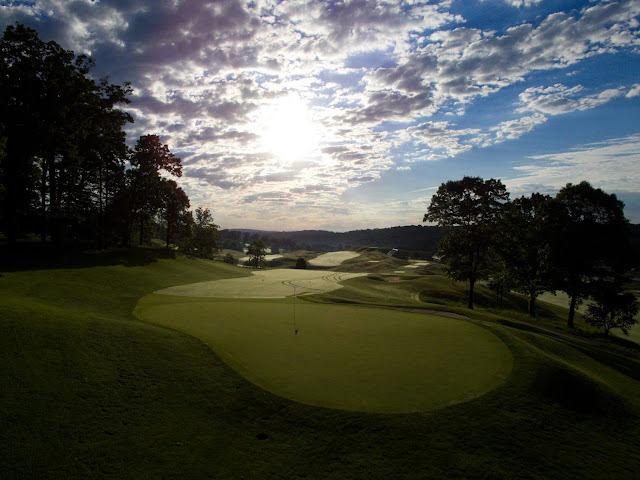
The redesigned 10th from new green tee (the title picture is the original design) 

The new men’s green/blue tee was always part of the plan, but the club was not allowed to build it during the initial construction phase. This tee not only affords an exciting new angle to the hole, but also provides valuable teeing space as the current tee sees a lot of traffic and is always covered in divots. Further, it was decided to add a new forward tee from the same angle, that could be used on special occasions, or for those who play the gold or white tees who wanted the alternate angle, but not at the longer distance. We do not expect it to be used a lot (and hence it is not very large), but adding it at this time made sense. 

The first draft for the redesign on 10


The USGA report showed that out of the 200 sample rounds recorded no one used the fairway on 10! While it was understood that some like to use it (or at least know there was a bail out), the fact stood out that it was an area that was unnecessary. Also, many felt that it looked a bit odd (like a second green), helped with the decision. Replacing it with rough makes it a slightly easier shot for anyone who may end up there, as it will be easier to hit than chipping from a tight lie. Removing the short fairway meant that the orange forward marker no longer had a home, so a small tee/ball drop was added for this purpose. This tee will become part of another hybrid course for beginners/occasional golfers, where it will be a gold/orange tee negating any shot over the pond. 


Redesigned 10th from new gold tee 

The new bent grass approach in front of the green was a late add on by Bryce as he noted how many people ended up short (and it has been amazing to see how many landed on it while we were working there). Now anyone that lands short of the green has the option to putt rather than chip which may make the hole more appealing. 


The bunkers on 10 were some of the worst on the course both for maintenance and playability. When discussing rebuilding them it was decided to reduce the size as much as possible (for labor savings) and the far right bay near the woods was eliminated, as it never saw play. The new bunkers are lined with Blinder to ensure longevity. It will take a few weeks for the sand to fully compact at which time some more will need to be added to make sure it is all the correct depth. 


The new approach on 6 was also done based on the USGA’s and the Rees Jones reports. The complaints of balls rolling right and coming to rest against the rough in a poorly draining area have been coming for years. Upon consultation with Rees, Keith Evans (Rees’ lead on the initial course design) added more fairway to the left to encourage player to go left and feed the ball onto the green. While this did work to an extent, the complaints still came about balls stopping to the right. The concern was adding fairway to the right would make it a tougher shot to the green, but after the USGA report and consulting with Bryce they said to add it. 


The plans for 6


6 completed

It still provides the opportunity to putt using the bank on the left to feed onto the green and while not the direct way, it provides a safe option to a tough shot. Sod was available from the removal of the fairway on 10, so it made sense to complete this improvement. The area was regraded so balls will not collect in the same spot and now drains better, so it should play a lot better than it did. 


6 before (left) and after 

The lower fairway bunker on 11 was removed as few golfers went in it, based on the USGA report. It was also a maintenance nightmare as it didn’t drain. Last year we fixed the drainage only for it to clog again a few months later. Removing it will have little effect on play. Surprisingly, removal did not affect the aesthetic, but it will save money by not requiring maintenance. 


11 before (left) and after 

The next project in planning is #17. There is a plan being finalized to make the hole play better for players of all abilities. The first phase is a new forward tee. This has been in the planning for a while (you may have noticed the fill being installed over the last few years). The plan is to make this part of the gold/orange hybrid course. It provides an opportunity for those players who struggle to cross the wetlands on 17 to tee up and start the hole on the green side. I believe the new tee will be about 160 yds uphill. While still providing a challenge to what is a very tough green, the planned elimination of half of the cross bunker and regrading of the bailout landing area will enhance play for ladies from the new tee and ease the anxiety of crossing the wetlands for the gentlemen, which is one of the toughest shots in golf. 


If you have any further questions or concerns, please let me know: alan@ledgerockgolf.com 


Sample of the information from the USGA report 


Sample of Rees Jones recommendations for the course 


Sunday, June 10, 2018

Spring 2018


The blog update always seem to find a way to the bottom of the to-do list but the plan is to have an update at least once a month from here on.

It wouldn’t be an update without talking about the weather - what a wild ride 2018 has been so far! The winter never wanted to end and then April ended up being one of the coldest ever. It looked like May would be the same but it was actually warmer than normal, mainly due to the warmer nights.


So what did that mean for the course? The cool weather resulted in an extended healing period after spring aeration. There was a PA Golf Association event in early May so it was decided to move spring aeration up this year in hopes that the greens would be healed for the event - with the side benefit that they wouldn’t have lots of sand on them for GAP Matches. The plan worked in that the sand was mostly below the canopy for the GAP Matches and the greens were in good condition for the PA Golf Association event, even if some of the holes were still visible after six weeks. Soil temperature drives growth, with cool season turf starting to wake up and start growing in soil temps in the mid 50Fs. Bentgrass really gets going once it gets into the mid 60Fs. The bentgrass variety at LedgeRock is also one of the slower varieties to get going in the spring, which also compounded the issue. It seemed like the last few springs were cool and it took forever to warm up but 2018 consistently was three to four weeks behind.  The soil sensor data below shows just how much longer it took to warm up this year (the blue line shows the average soil temp of 55F).


Spring 2018: The average soil temperatures above 65F only start around May 1 and it only gets into the mid 50Fs around April 22.

Spring 2017: The average soil temperatures above 65F start around April 23, however it hits mid 50Fs in early April

Spring 2016: The average soil temperatures above 65F start around April 23, however it hits mid 50Fs in early April

Due to the amount of rain the course looked great and played as good as it ever has when we were actually able to dry it right down. Since then the overall weather pattern has been wet. I’m surprised how well the course has handled it. The club has been lucky to miss a lot of the bigger rains, which means that regular maintenance and letting carts out on course hasn’t been too much of an issue and the Founders Cup was a big success.


Every decision on what needs to be done on the course has to ensure that it will not set the turf back for the summer so skipping a rolling or mowing when it’s wet pays dividends later in the year. Just a reminder too that carts can do a lot of damage when it’s wet, especially in areas like drive offs where the traffic is concentrated so it is imperative that the traffic control measures are followed at these times.


The greens were top dressed lightly on Thursday 7th for the first time since aeration. This helps with smoothing the surface along with thatch management which helps with firmness. This would usually have been done earlier but due to the schedule and the cold and wet weather this was the first time it was able to be done. There are a few more planned as the summer continues and as the weather permits.


The Poa annua populations on the greens have increased a little this year, largely due to the wet cool weather in which the poa thrives and which bentgrass does not like (and therefore isn’t competitive against poa envasion). While the populations are still greatly less than one percent the spots are getting more visible and numerous. We still plan to dab and pick it, but there is enough now to look into more widespread applications to kill it. A product called PoaCure has been in trial with great results however the poa at LedgeRock was not bad enough to warrant trials prior to this year. The turf program at Penn State is helping us to trial the product on the 16 green which is one of the worst. We are confident that it will work and we hope that the product will become available next year.

Poa being eaten by Annual Bluegrass Weevils on 4 green. The strip of green are bentgrass plugs from a few seasons ago - the weevils are not eating it (yet!)

Dr. Fidanza at Penn State is also helping with a trial of other poa controls on the collar of the small practice green. These applications are duplicated around the collar and once we have data from that - ie how will they kill poa and how well the bentgrass can survive the treatments, the trail will be modified and repeated. Poa is a very aggressive plant and can adapt to changing environments quickly. Due to this it is important to have multiple control products that can be alternated to ensure long term control so the practice green trial is very important. There may be some dead grass on the collar but they will be sodded out once we know how the products work.


The fescue areas are looking great and a lot of people have asked about not mowing them. I’m still debating what to do but most likely they will need to be mowed so the weeds can be sprayed and the thicker areas do not get out of control.


Lastly, I had the opportunity to visit some of the top courses of the world this year that I had not been to before. I finally made it to Augusta for the Masters - I went with high expectations but still was blown away by everything, it was an amazing experience. Earlier in the Spring I went to the BIGGA (British and International Golf Greenkeepers Association) conference in England and visited with staff from Royal Birkdale and the superintendent at Royal County Down. This week is the US Open so I’m also looking forward to checking out Shinnecock Hills. I love visiting other properties and seeing what they do and how they work. Its great to see what we're doing right and to pick up some new tips, trick and see if we need to step up the game!

 Royal Berkshire GC

   Royal Berkshire GC

 Royal Berkshire GC

  Royal County Down GC

   Royal County Down GC

   Royal County Down GC

  Royal County Down GC

As always email me alan@ledgerockgolf.com with any questions or concerns.


Wednesday, July 26, 2017

Course update! How is the course surviving the wet summer


I wanted to send out a quick update on how the course is doing with the unusually wet weather this summer . There has been over 10” of rain since June 1st; 6” of which has fallen since July 1st. The heat and humidity has varied but with stretches where it has been very stressful for turf. 


Disease has been difficult to control with early breakthrough even having used very good fungicides. This has been frustrating, but overall damage has not been too bad other than some scars on a few fairways - which will grow out in due course. We do not regularly spray the roughs due to cost, so it too has seen attacks of dollar spot in particular, but again it is superficial and will grow out in time. All the areas have been sprayed so all the disease is in check, which coupled with the cooler forecast should result in no more issues. 

Dollar spot in fairway

As for the greens, they are all performing exceptionally well – including the pocketed greens that have caused issues over the last few years. The work that has been done to create better growing environments has paid off resulting in excellent rooting and as a result they are very healthy. With only four weeks until fall aeration they are better than they ever have been at this time of the year. While natural rainfall usually helps turf, the excessive amounts seen this summer would normally be detrimental to the "bad" greens as they have a difficult time drying out; so to have them in as good health as they are considering the wet weather is exceptional. The one benefit of the wet weather is there is no reliance on the poor irrigation water.  


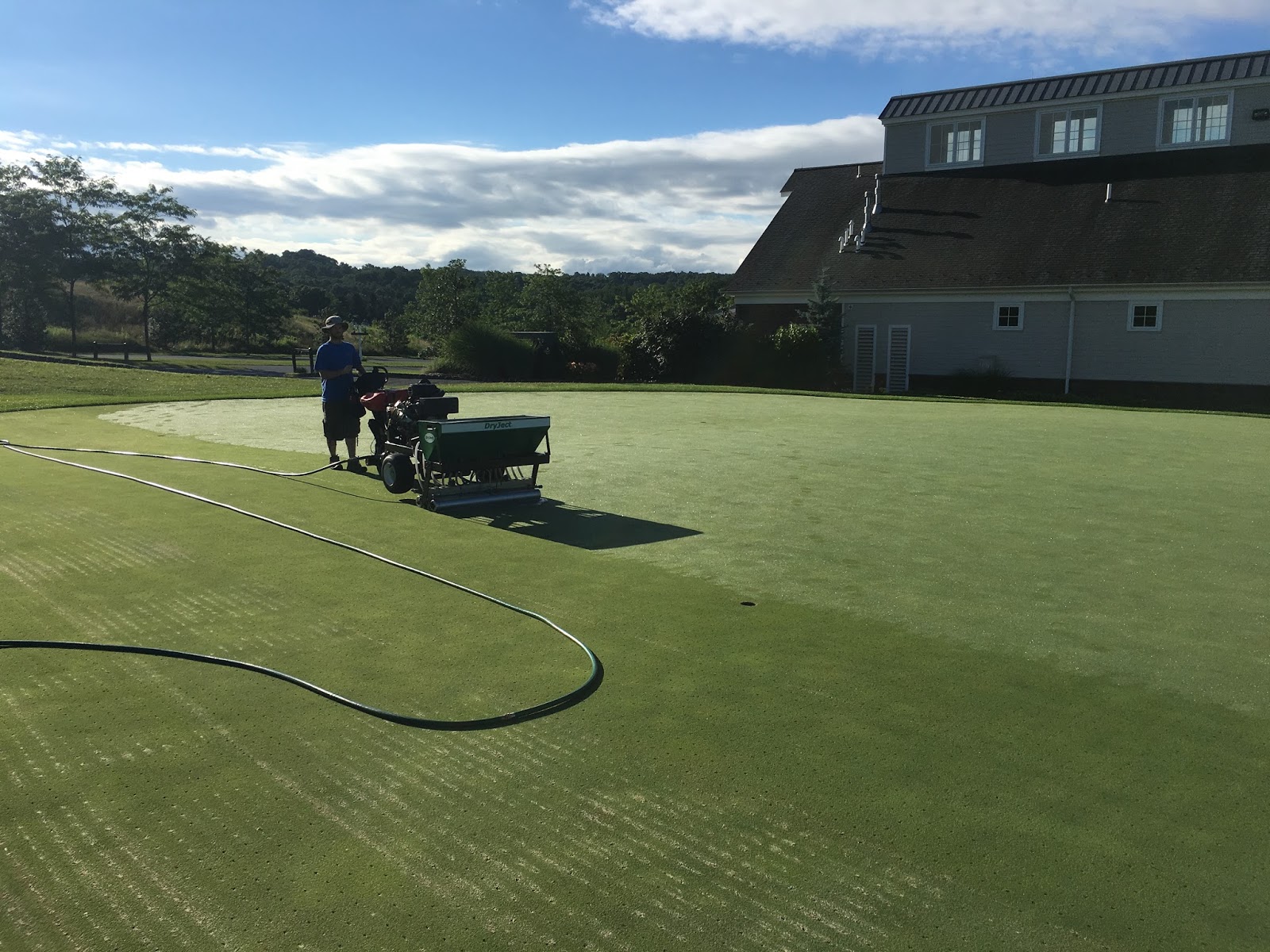
Hydrojecting with Dryject machine


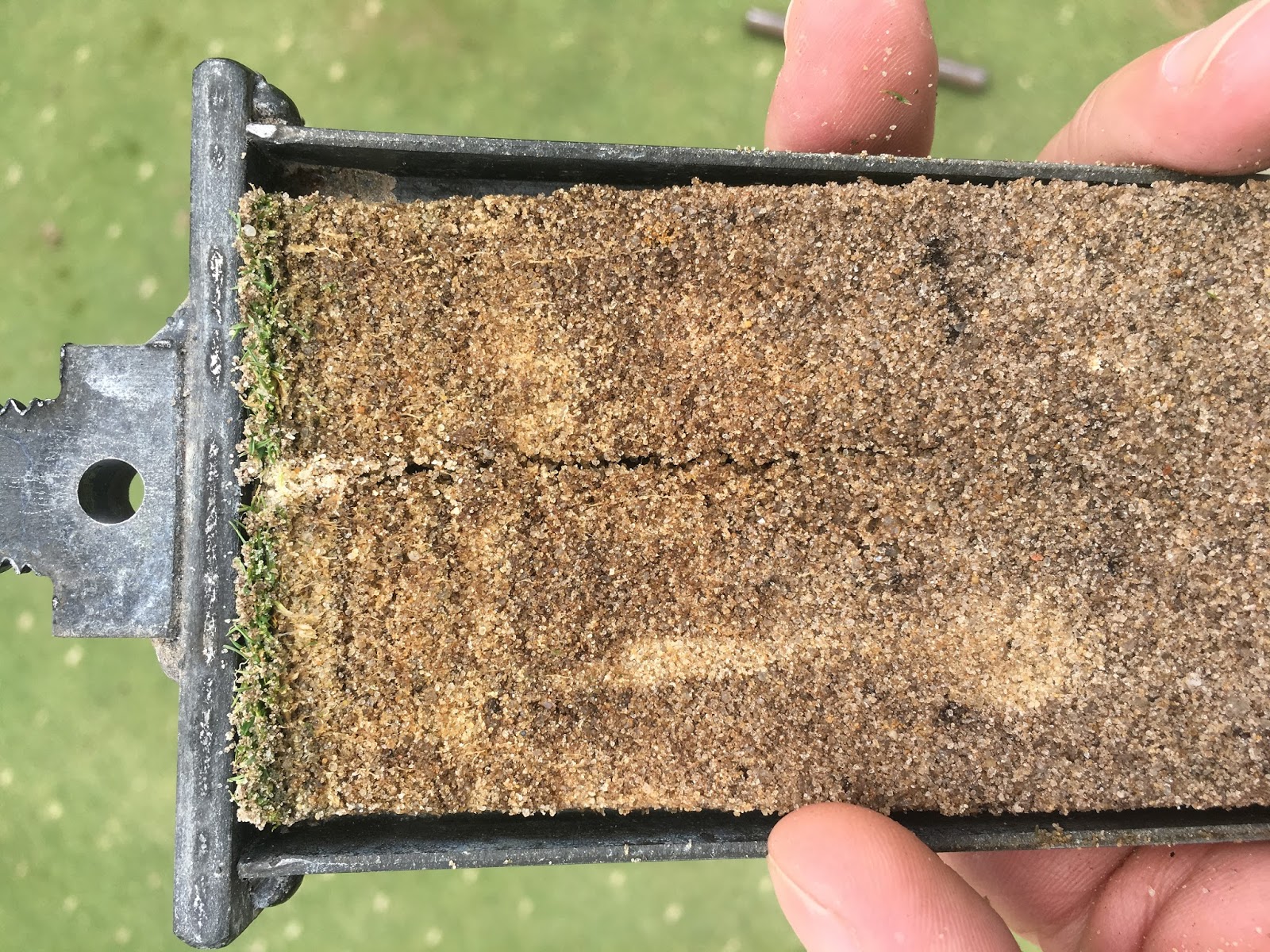
The greens have been stimping in excess of 12ft all summer but they need rest from time to time. On Tuesday they were hydrojected (using a Dryject machine) which injects water at high pressure to create aeration holes. This is a very non-evasive procedure and also helps move organic material lower into the profile. The operation on Tuesday worked perfectly and coupled with resting the greens for a day means that they should have no problem staying healthy and playing at full speed right up to fall aeration. It does mean that they temporarily lost speed but is worthwhile when the result is having perfect surfaces the remainder of the summer. 


Hydroject hole (crack) in green profile


One little issue on Tuesday was one of the machines had a hydraulic leak on 16 & 18 greens before it was noticed. The oil is very hot so scorches the turf. Usually that is the extent of the damage. We did spray some products on the turf to help move any oil off the plants which will also help recovery. It is too early to say how the turf will look but worst case will be brown lines on the greens for a period. The surfaces will putt fine other than the discoloration and any work to try and make it better will result in poor surfaces. With the fall aeration only a month away, the lines will slowly heal until then and the aeration will help heal the rest. 

 Hydraulic leak lines on 18 green


So overall The Rock has made it thought the summer in great shape and while there is another month to go to fall aeration, the entire course is further ahead of where it normally is, which puts it in a great position to play exceptionally well for the rest of the summer. 
  

As always if you have any questions, please let me know: alan@ledgerockgolf.com

Saturday, July 1, 2017

2017 to Date!


I was scrolling through my blog last week and noticed that it’s been over 6 months since my last post. I can't believe how quickly the year has passed and that the blog has been neglected for so long. Luckily there has been a lot going on at the Rock in 2017 so there will be no worries about writers block for a while!


So far, 2017 has been off to a busy start. The last of the projects were recently finished up (just in time for the first heat wave of the year!). Since my last post, these projects were completed:
  • The barn work was finished along with the new chemical/fertilizer mix tank. 
  • Over 100 trees removed and those area were sodded. 
  • Three bunkers were rebuilt and some of the fairway lines were adjusted. 
  • Steps were added to the cart barn entrance.
  • The decking on some of the bridges has been replaced.


No update is complete without discussing the weather! Mother Nature has thrown us a curve ball this year with a lot of abnormal weather.

Overall, January through the middle of March was unseasonably warm. The course remained open so there was more play than normal. Since the turf isn't growing over the winter, play can cause damage to the course as the turf can't recover; however there was minimal damage. The plan was to start work in earnest on the projects once the maintenance staff started back, only for the course to get hit with an end-of-season snow storm. Luckily there wasn't as much snow as expected, but the foot that did fall delayed work on the course. This backed up the project schedule, which then snowballed with rain and play related delays. The goal was to have everything done by June 1, so even considering the delays they were only a few days late getting finished up.


There was a spell of nice weather right around the time the course was aerated. Over the last few years the opposite happened and the greens took a long time to recover. This year they initially recovered quickly but, when the colder than normal weather returned, they just sat for a period until the soil temperatures recovered to sustain growth. The benefit of the grass not growing was that it didn't need to be mowed, which in turn freed up staff to help get the projects finished up! Once the soil temps rose, the greens quickly finished healing. With the weather (mostly) cooperating, the spring aeration went really well with quicker recovery than was observed the last few years.


Rooting in the greens was ahead of schedule with the warm spring weather. Unfortunately, the cooler, wet weather (which bentgrass doesn't like) in the later spring saw some of the roots retract. The growth over the last month has seen them recover once again and they are really healthy going into the summer.


The TurfGuard sensor graphs above and below show the four-week period after aeration throughout the 2016 and 2017 springs. In 2017 (above) there were more days with soil temps above 65F, which shows how much the weather has control over healing time. It also shows the period where recovery slowed when the soil temperatures dropped for a period. 


The Driving Range tee also fell foul of the cooler temps. The grow-in of the tee rebuilding project went well as the tees were covered over the winter. This resulted in good germination and growth. Once the temperatures rose in April the covers were removed as the temperature and humidity under them increased, which, in turn, would damage the grass. When the temps dropped again the turf growth slowed and the tee didn't grow much until the soil temps rose again. It was also a cloudy period overall, which bentgrass doesn't like. Just like with the aeration recovery, once the soil temperatures rose back to optimum levels and the sunshine returned the tee filled in and was opened for play on the 14th.


The range tee after the covers were removed. 

The germination under the covers over the winter provided a good head start for the spring. The removal of the covers so the tees could be consistently maintained coincided with the period when temperatures decreased. This slowed the grow-in down. The Learning Center was being painted during this time, which prevented the driving range tees from being irrigated for a week and slowed the grow-in down a little.


The new tees. 

The surfaces are a lot firmer since there is no thatch, which was an issue with the old ones. The two tees are now connected with a contoured area to better replicate uneven lies and the new practice bunker (to the right of the tee in the pic above) was designed to provide different shot types.


Over the next few weeks, I will cover more of the work that was done in the recent months. As always, if you have any questions, please let me know: alan@ledgerockgolf.com. I hope to see you soon!